Se afișează postările cu eticheta Books. Afișați toate postările

miercuri, 9 ianuarie 2019

The Burnout


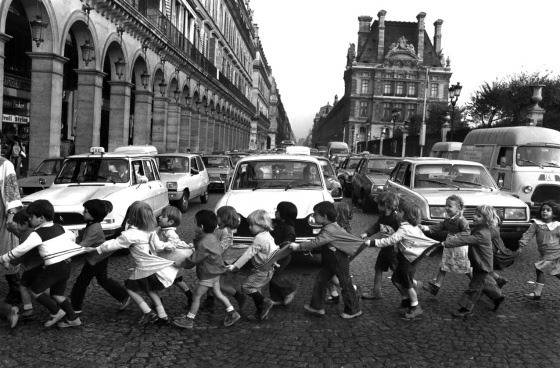
Robert Doisneau. Les Tabliers de la Rue de Rivoli. 1978. 


Being part of the so-called burnout generation, the dreaded millennials, even in its earliest instances, is not an easy thing to come to terms with. Aging is hard for everyone, that is a truism, obviously, but it seems to be harder to us, accepting the adulthood and turning to be an adult into a verb.

What does it even mean? Getting married, having kids, taking the place of our parents in decision-making? Oh well, then I only check one out of three. There is a joke about being scared when people ask for the adult in the room, and you panic and look around for a ”more adult.”

Doing the clean-up for Christmas, I noticed a photo from my parent's wedding, with them and my aunt and uncle. Respectable adults. And it hit me: they were in their late 20s, early 30s at that time, 8 years younger than me now. I showed up when mom was 25 and dad was 32. My grandmother had her first stroke when my mother was 31. By the time mom was my age, I was going to high-school. And that brought perspective. There are people in my generation that have kids ready to got to high-school. Do they feel old? Did my parents feel old in their late 30s? Never asked, maybe I should.
Do I feel my age now? Hell, no. Sometimes I still feel like answering I am 28 when asked. It is doubtful to me too. And yet, after all these years, with two burnouts under my belt and another one creeping in, I get it. We are the burnout generation, burning bright, putting all our efforts into actions with impact. High energy, low impact activities are skipped, moved further down the line in the to-do list and innovations come for them: the dishwasher, the Roomba…

In the brief introspection about the lives of my parents as compared to my own, I still wonder how they could do things which seem unattainable for me. Mom was washing clothes weekly, outside, in a tiny washing machine, that required taking them out and rinsing them in three or four different tubs of cleaner and cleaner water. Oh well, I still need to take the clothes out of my washing machine, that rinsed and dried them. Too hard. My parents came home from work, had a meal with me and then left for the theatre or a restaurant with friends. How many times did you manage to get back home before an evening event? In my case, twice in a year, in special circumstances. I just link meetings, work, salon and doctor appointments in a stream, input in my Google Calendar, optimized to fit as much as possible. Is the world running faster? Are we busier? Why? Will I be as happy as my parents are in their 60s? Probably not, although I travel more in a year than they did in a lifetime.

It is all a matter of approaching time. We alternate periods of high activity with stretches of laying on the couch and binge-watching Game of Thrones, or playing whichever video game is cool at the moment. We are very much sinusoidal in our approach to time, and their generation was more linear.

And I did find my ”spirit animal” writer in Clarice Lispector, a millennial before her time when she wrote in The Stream of Life

“Oh, living is so uncomfortable. Everything presses in: the body demands, the spirit never ceases, living is like being weary but being unable to sleep–living is upsetting.” 

Reading her, a part of my parents generation, felt like all this dichotomy of us versus them, my generation versus theirs is fake. They did not write blogs, but journals, they are fearing getting old and frail and missing out on things as much as we do. But we have a stranger kind of resilience, and we should take to heart more their resilience. There are millennials of all ages...


How do all these things fit into the story of a burnout? Maybe they don't. I guess I am just rambling because birthdays are hard when one still has imposter syndrome when called an adult. But there is a burnout creeping in, and perhaps that is a sign of a much-needed change in my approach to time and the activities which fill it. And I am not alone in this... I have an entire generation with me.


marți, 19 iunie 2018

Beach Reads


Mid-life crisis continues. Inspiration to write is elusive so when a friend asked for a recommendation for something to read during the summer holidays, I jumped right on the topic. I am, by no means a literary critic, nor am I very up to date with the current listings on the book market, so here I made a short list of the books that have been in my beach bag for the past years. Some in Romanian, some in English, they range from thrillers to historic, from biographies to essays. About 20 of them, with Links from Amazon, because Kindle and Carturesti for Romanian.


The list could be longer, and perhaps I may add to it. But the beach calls and I’d rather read than write J


marți, 6 martie 2018

On Identity and Mid-Life Crises


Image via Pixabay. Unfiltered. 


Going through a mid-life crisis when you are 37 is uncommon in modern day and age, but I am. Hence not writing anything here for the entire month of February.

I struggle to find spots of balance, so I turned to my usual: research. No place better than the book near my bed. I am not the first one to write about Hume helping someone out of a midlife crisis, and I probably won’t be the last. What resonates is not that we have both walked the streets of Edinburgh, albeit two centuries apart, but that feeling that he was going through the same. Written when he was 27 (basically at his mid-life), A Treatise of Human Nature asks questions about what and who we are, what makes and breaks us. Issues of identity, utility, and meaning have been to the forefront of my mind for the past months, ever more present and overwhelming to some extent. But Hume comes and says
“I may venture to affirm of the rest of mankind, that they are nothing but a bundle or collection of different perceptions, which succeed each other with an inconceivable rapidity, and are in a perpetual flux and movement.” 
He talks about reflection and the fact that we are not at any moment away from our perceptions. We filter reality through biases and lenses. We are a plethora of Instagram worthy images we build inside ourselves, often skewed by the Lo-Fi or the Kelvin or the Valencia of hurts and joys.
Is this sudden awareness of the passing of time more rapidly, of lack of impact, of loss of utility and meaning as a person the reality or just the Maven filter of a distorted perception? The Maven is the one that darkens the shadows and increases the gloom. But even the Maven enhances the right image, it fits with derelict buildings and empty branches. So perhaps this filter of sadness just supports the embrace of unexpected beauty in things that are useless and just take out space that could be used more efficiently Hume answers this one as well:
 “Beauty is no quality in things themselves: It exists merely in the mind which contemplates them, and each mind perceives a different beauty.”

Perception again. Biases. Lenses. Filters we apply to ourselves and to others. I am testing a different filter now: empathy. There is this book that brings the latest thoughts in my soul to page, because it talks about clinging to banality while thirsting for significant barometers, it deals with pain translated via metaphors to communicate, it brings the need of an effort to travel to the pain of oneself and to the pain of other like to a new country, expecting disaster, but also encountering beauty. The Empathy Exams.

Do I fail these exams now? Probably. Not about others. Jamison says that empathy is listening. I still listen, I still inquire, I still let myself be immersed in the metaphor of other people. But somewhere along the way, I lost the metaphor of me. Viewed through the lens of Hume, I perceive external elements, but the internal is empty and numb. This is perception as well. I perceive that I do not perceive anything there. I am inquiring, so I gather this is the first step of the effort that Leslie Jamison talks about in the next quote. I just need to find the energy and the curiosity to take the following steps as well…
“Empathy isn't just something that happens to us - a meteor shower of synapses firing across the brain - it's also a choice we make: to pay attention, to extend ourselves. It's made of exertion, that dowdier cousin of impulse. Sometimes we care for another because we know we should, or because it's asked for, but this doesn't make our caring hollow. This confession of effort chafes against the notion that empathy should always rise unbidden, that genuine means the same thing as unwilled, that intentionality is the enemy of love. But I believe in intention and I believe in work. I believe in waking up in the middle of the night and packing our bags and leaving our worst selves for our better ones.” 


marți, 9 ianuarie 2018

On Extraordinary and the Power of Ordinary

(Photo source: ValenciaGroup)


We like to imagine ourselves as extraordinary, heroes of our very own legend. Slightly challenging to be exceptional in a world of billions, and there is power in being ordinary but better. Picturing ourselves as unique and having a society more often than not prove us wrong leads to frustration, to a bitter aftertaste of a stale lemonade that was meant to be refreshing.  We seek the extraordinary, but we need to struggle with everyday tasks, bills, angry neighbors and boring encounters. There is nothing remarkable in feeding your cat, but there may be.

After all, resilience comes from ordinary processesWhen life gives you lemons and all that cliché…

Fascination, pure enjoyment, and curiosity may transform dull tasks and mundane hustles into sources of extraordinary. Stay at the moment: there are tiny joys to be had in doing the dishes, decorating a Christmas tree, watching a bird rest on a branch outside your window… Don't you have the time for it? What do you have the time for? Does it sound like New Age annoying empty speech? Perhaps. Writing about turning prosaic into poetry may seem… well… prosaic.

There is this book I love a lot: An Extraordinary Absence by Jeff Foster. And Jeff (who does sound New Age-y with a more rational twist, and he keeps this tone in all his books) talks about how we seem to get the thirst for life when we are in limit situations: we value breath more when we don’t have it quite as easily. So why do we need to wait for the limit, for the extraordinary, to enjoy life?

I know that my psychologist would agree that I should adhere to this quote by Jeff as a mantra, she seems to tell me this constantly: 
“Stop thinking your way through life, always trying to work it out before living it. Life is to be lived, not analyzed to death. Feel”